
Welcome and Thanks for Reading!
Today’s Writing Tip Topic: Crafting the beginning steps of building a speculative fiction government.
The basics of a government start with the structure of the government. The very first step you must decide is what type of government fits your story. There are many to choose from and each has its own strengths and weaknesses.
The common forms are democracy, republic, monarchy, dictatorship, and oligarchy, but these are far from the only ones to choose from. For a complete list of types of governments, including some theoretical ones, and their definitions, see this useful wikipedia site. It’s worth noting that some of these can be a combined. For example: a timocracy (or rule by the honorable) can be a democratic form of government, where the only people who get to propose laws and have a vote are the most honorable people in society.
From here the real work begins. This is where you must start asking questions of yourself to get the ball rolling. In our democratic timocracy for example, where the only people who can vote are the most honorable, who decides most honorable and how? Maybe the others who get to vote decide who is honorable and accept them into their ranks. How does this form of government protect against corruption and nepotism? Maybe it doesn’t and corruption defines this government system.
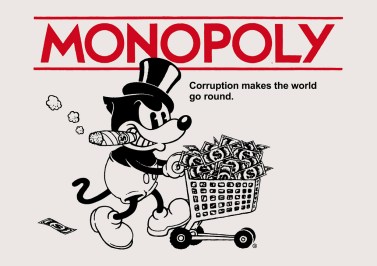 [Monopoly Mickey Mouse! No!]
(CORRUPTION by Christopher Dombres)
Now, if you’re looking for a quick way to build a basic government, because its either not where your interest lies or it’s not really what your story is about, that’s okay too. I recommend, in that case, choosing one of the common five and looking at real life examples. You may not need to build much for your society if politics isn’t going to be a major focus, but, important note, even if its not going to play an important role, you should have answered some basic questions.
For example, if you are using a democracy, who can vote? This will effect your character regardless of class. If your character is a poor non-landowner, who cannot vote, how does this character view a government he or she cannot participate in? For example of a democracy, take a look a classical Athens.
Likewise, if you are building a republic, you need to consider who can vote as well. But you also need to consider who can be a representative? Is it only wealthy landowners? Military officials? Or can anyone become a representative? How are representatives chosen? How many bodies of legislature are there? Traditional is two. You can have only one or three, but you will need to consider why this legislature evolved the way it did. How does a law become a law? Who can propose a law? A republic needs the most basic questions answered, but luckily for those who decide to build a republic there are a lot of examples. If you are looking at an ancient example: the roman republic is a good example. Modern day ones include: The US, the UK, France, Italy, and so on.
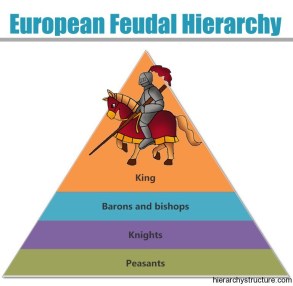
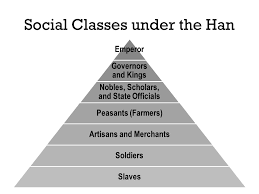
If you are building a monarchy, how is the rest of the ruling class decided? Are they hereditary titles, such as Duke, Marquis and so on? Or are they appointed ministers in a more bureaucratic monarchy? For real life examples of the two forms, look at the difference between feudalism in Europe and the more bureaucratic Han Dynasty in China. This will have an impact on a citizen of any social class.
Let’s say your character is farmer. In a feudalistic society, this puts them at the bottom of the social structure. They are peasants, dependent on the knights for protection and on their lords (the Barons and bishops block in the above triangle) for the land to farm and often times, shelter. Feudalistic societies are designed this way for a reason. If peasants are at the bottom of the triangle but they own their own land, then they have little reason to pay or obey the lords. Loyalty in a feudalistic society is dependent on what is offered by the higher ranking classes.
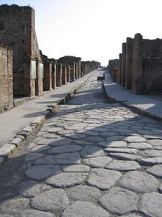
[Sadly, I could not find a picture of a road from the Han Dynasty, so you’ll have to settle with this road from Pompeii instead. Rome was also an example of centralized government!]
(Roman Street in Pompeii by Paul Vlaar)
In the Han Dynasty things were set up differently. Rather than having decentralized governments (that is, that land owning nobles ruled over their own territories with power relative to the size of the land granted to them by the king), the Han Dynasty was a centralized government. The government and ministers provided necessary infrastructure as well as facilitated the growth of technological advances. For example, in order to facilitate tax collection and military movements, the government paid for and maintained roads. This had the advantage of facilitating communication and trade. Two very important things for farmers. This meant that farmers could own their own land and still have a responsibility to pay the government. The government was providing a service to the farmers that in a decentralized government would be much harder. A common road system was still in existence in the European feudalistic society, mainly because the Romans, another centralized government had already built the roads. However without the centralization of a bureaucratic government, trade between fiefs by the farmers themselves was difficult. This highlights the major differences between these two styles of governments and how it effects characters of any given rank.
Dictatorships and Oligarchies will need some world-building as they require you to consider what form they will take. For example, a dictatorship that evolved from a monarchy will look very different from a dictatorship that evolved from a republic. Who holds power is an important question in both of these forms of governments. Who appears to hold power is another important question. Is it the individual or individuals who actually hold power or is there a puppet government?
For example, perhaps this is an oligarchy that appears to be a republic. Maybe on the surface, the representatives work for the people, but its really a select few wealthy individuals who are deciding the laws and telling the representatives how to vote. Or alternatively, this could be a dictatorship disguised as a republic. This dictator has already taken down any checks and balances on his power, but keeps the representatives around to give off the appearance that he isn’t really sole leader of the country. A president or similar who is miraculously voted into power again and again and again may very well be a dictator who is holding pretend elections. How this affects your character will vary, but it will affect your character. Both of these forms of government will affect your character more in how they consolidate power than the actual form of government.
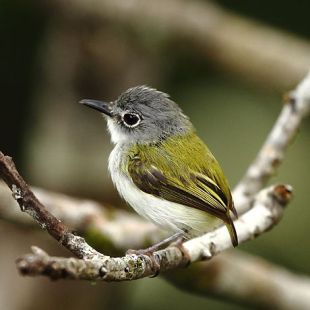 [‘Tis a Tyrant! Oh no!]
(Short-tailed Pygmy Tyrant by Hector Bottai)
For example, Stalin’s Russia is very different than living in modern day North Korea. Under Stalin, Russia became a military and industrial superpower. North Korea on the other hand, while terrifying the world with their atomic bomb research, isn’t much of a military or industrial superpower. However, there are many comparisons between the two. For example, the brutal execution of their enemies and those who resist.
In the future, I will discuss each of the main five individually (Yes, there is more I can say on monarchies. I love monarchies.). I encourage you, as you are building your governments to look at real life examples. It may feel like the worst part of world-building (who likes politics? Oh wait. Me. I do.), but it affects your characters. The same character living in a feudalistic monarchy has a very different life from one living in a direct democracy.
This was a long post, so thanks for everyone who stuck around with me! As always, remember, in writing there’s no such thing as absolute advise. Enjoy your story and have fun writing!
 Current Projects